Posted by: jakinnan | March 27, 2013

A Man on a Mission

mountains - w119

Chesterton conducted something of a personal experiment to see what the overall impression would be if a person simply read the Gospels without any previous information regarding Jesus. What he found surprised him:

It is full of sudden gestures evidently significant except that we hardly know what they signify; of enigmatic silences; of ironical replies. The outbreaks of wrath, like storms above our atmosphere, do not seem to break out exactly where we should expect them, but to follow some higher weather-chart of their own.4

Oh, but they do make sense, when you understand that this is a man on a mission. That the same man who could be so playful is also a man on fire. If you would know Jesus, you must know that this—his fierce intentionality—is essential to his personality.

Nature bears witness. Picture an African lion, stalking through tall grass, closing in on its prey—the ruthless focus, the vigilant keenness. Or the gaze of a silverback gorilla when he turns to confront an intruder crossing the hidden boundary of his band. How about a mother brown bear when her cubs are threatened? Six hundred pounds of unrelenting fury. Now imagine you are watching one of these scenes not on the nature channel but from thirty feet away. Oh, yes, we find a very fierce intentionality in nature—reflecting the personality of the Artist.

-John Eldredge, Beautiful Outlaw

Posted by: jakinnan | March 27, 2013

03/27/2013 Scripture

mountains - w076

Two are better than one,
because they have a good return for their labor:
 If either of them falls down,
one can help the other up.
But pity anyone who falls
and has no one to help them up.
Also, if two lie down together, they will keep warm.
But how can one keep warm alone?
 Though one may be overpowered,
two can defend themselves.
A cord of three strands is not quickly broken.

-Ecclesiastes 4:9-12 NLT

Posted by: jakinnan | March 26, 2013

Jesus’ Humility in Death

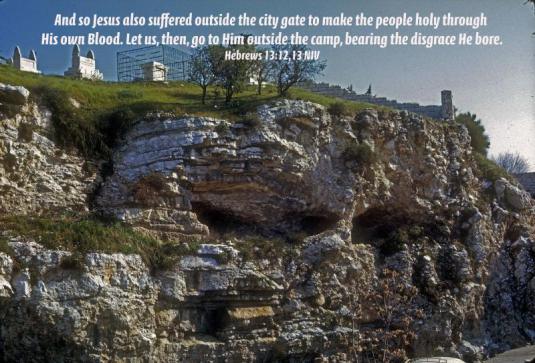
golgotha

“He humbled Himself by becoming obedient to the point of death, even death on a cross.”
– Philippians 2:8

In His suffering and death, Jesus is our supreme example of humility.

We naturally react to injustice with deep hurt and an assertion of our rights. But Jesus’ response to His accusers did not include one word of angry defensiveness. Matthew 27:12-14 tells us: “And while He was being accused by the chief priests and elders, He made no answer. Then Pilate said to Him, ‘Do You not hear how many things they testify against You?’ And He did not answer him with regard to even a single charge, so that the governor was quite amazed.”

Later on, during His sham trial, Jesus continued to humble Himself. He accepted sinful men’s abuse when they whipped Him, stripped off His robe, planted a crown of thorns on His head, mocked Him, spat on Him, and beat on Him with a reed. Christ did not even demand His rights when He was condemned to death and forced to walk to Calvary half-naked with a cross on His back.

Today’s verse underscores the most shocking aspect of Christ’s humiliation: the kind of death He died. He endured crucifixion, the cruelest form of death ever devised. The Romans used it to execute rebellious slaves and the worst criminals. Because He was King of the Jews, Jesus’ death on the cross was seen as especially horrible by His people. The Jews had long known what the Law of Moses said: “He who is hanged [on a tree] is accursed of God” (Deut. 21:23). From everyone’s standpoint, the Son of God suffered the ultimate in human degradation.

But in spite of the detestable treatment He suffered, Christ graciously and lovingly died for sinners like you and me. Such an example of selfless humility ought to motivate us, His followers, as we minister to others, “since Christ also suffered for you, leaving you an example for you to follow in His steps” (1 Peter 2:21).

Suggestions for Prayer:
Give thanks that Jesus’ example of humility extended all the way to His willingness to redeem you.

For Further Study:
Read one of the Gospel accounts of Jesus’ suffering and death (Matt. 26—27; Mark 14—15; Luke 22—23; John 18—19). Record some observations about His general attitude during the ordeal. In what situations and ways does He show humility? If you have time, compare and contrast two of the accounts.

Posted by: jakinnan | March 26, 2013

Left Alone

miscellaneous photos - w102

Few had fellowship with the sorrows of Gethsemane. The majority of the disciples were not sufficiently advanced in grace to be admitted to behold the mysteries of the agony. Occupied with the Passover feast at their own houses, they represent the many who live upon the letter but are mere babes as to the spirit of the Gospel.

To twelve, no, to only eleven the privilege was given to enter Gethsemane and see “this great sight.” Out of the eleven, eight were left at a distance; they had fellowship, but not of that intimate sort to which men greatly beloved are admitted. Only three highly favored ones could approach the veil of our Lord’s mysterious sorrow. Within that veil even they must not intrude; they remain a stone’s throw apart. He must tread the winepress alone, and of the people there must be none with Him.

Peter and the two sons of Zebedee represent the few eminent, experienced saints who may be written down as “Father”; those doing business on the great waters can in some degree measure the huge Atlantic waves of their Redeemer’s passion. To some selected spirits it is given, for the good of others and to strengthen them for future, special, and tremendous conflict, to enter the inner circle and hear the pleadings of the suffering High Priest; they have fellowship with Him in his sufferings, becoming like Him in His death. Yet even these cannot penetrate the secret places of the Savior’s woe.

“Thine unknown sufferings” is the remarkable expression of the Greek liturgy: There was an inner chamber in our Master’s grief, shut out from human knowledge and fellowship. There Jesus is “left alone.” Here Jesus was more than ever an “unspeakable gift!” Is not Watts right when he sings: And all the unknown joys he gives, Were bought with agonies unknown.

-Alistair Begg

Posted by: jakinnan | March 26, 2013

Love in Action

miscellaneous photos - w079

His ability to live with all these qualities we’ve seen, in such a way that no one quality dominates—as is so often the case in our personalities—eclipsing the richness of the others. To live in such a way that there is always something of an element of surprise, and yet, however he acts turns out to be exactly what was needed in the moment. Oh, his brilliance shines through, but never blinding, never overbearing. He is not glistening white marble. He is the playfulness of creation, scandal and utter goodness, the generosity of the ocean and the ferocity of a thunderstorm; he is cunning as a snake and gentle as a whisper; the gladness of sunshine and the humility of a thirty-mile walk by foot on a dirt road. Reclining at a meal, laughing with friends, and then going to the cross. That is what we mean when we say that Jesus is beautiful.

But most of all, it is the way he loves. In all these stories, every encounter, we have watched love in action. Love as strong as death; a blood, sweat, and tears love, not a get-well card. You learn a great a deal about the true nature of a person in the way they love, why they love, and, in what they love.

But it takes a beautiful heart to recognize the beauty in a scandalous act, and to love it as he does. This is why we say Jesus is beautiful. A Beautiful Outlaw.

-John Eldredge, Beautiful Outlaw

Posted by: jakinnan | March 26, 2013

03/26/2013 Scripture

BethphagePanorama

As Jesus and the disciples approached Jerusalem, they came to the town of Bethphage on the Mount of Olives. Jesus sent two of them on ahead.  “Go into the village over there,”he said. “As soon as you enter it, you will see a donkey tied there, with its colt beside it. Untie them and bring them to me.  If anyone asks what you are doing, just say, ‘The Lord needs them,’ and he will immediately let you take them.”

 This took place to fulfill the prophecy that said,

 “Tell the people of Jerusalem,

    ‘Look, your King is coming to you.
He is humble, riding on a donkey—
riding on a donkey’s colt.’”

-Matthew 21:1-5 NLT

Posted by: jakinnan | March 25, 2013

Sarah’s Fattening Coconut Berry Oatmeal

IMG_4393

Ingredients

2 pkt instant plain oatmeal
2 T coconut cream powder
2 T diced dried fruit blend
1 T natural coconut
1 T brown sugar
1⁄2 t cinnamon
1 c water (near boiling)

Instructions

At home, add all ingredients to the bag except for the water.

FBC method:
Add near boiling water to bag and stir well. Seal well and put in a cozy for 5 minutes.

Mug method:
Add near boiling water to mug. Stir well, cover tightly and let sit for 5 minutes.

Notes

Some coconut cream powders contain Lactose, look for it in natural food stores for a vegan friendly version.

Courtesy of trailcooking.com

Posted by: jakinnan | March 25, 2013

Jesus’ Humble Identification with Sinners

forest - w132

“. . . Emptied Himself, taking the form of a bond-servant, and being made in the likeness of men. And being found in appearance as a man, He humbled Himself by becoming obedient to the point of death, even death on a cross.”
– Philippians 2:7-8

Except for sin, Jesus experienced the everyday things of a normal man; but He was often not appreciated as the God-man.

Jesus could understand what people around Him were dealing with because He lived under the same conditions. He can also identify with us today. It is true that He never married, never went to college, and never used a computer or a VCR. But He still has perfect knowledge about such things, and more. The point is, Christ knows firsthand about our basic physical and emotional needs because He actually lived and worked in a world affected by the Fall.

But there was one element of our world Jesus did not partake in: sin. The conclusion of Hebrews 4:15 says He was “tempted in all things as we are, yet without sin.” Even though Jesus never sinned, He knows the struggles and temptations we face daily. Otherwise, He could not be the sympathetic High Priest that the first part of verse 15 mentions.

Although Jesus was a man who identified profoundly with those He came to serve, people around Him did not naturally see the most important thing about Him. Philippians 2:8 views Jesus from the perspective of those people. It says His human appearance was so authentic that most of them didn’t know that He was also God. Many of them simply could not accept that a man like Jesus could also be higher than them: “Is not this Jesus, the son of Joseph, whose father and mother we know? How does He now say, ‘I have come down out of heaven’?” (John 6:42).

Christ’s close identification with mankind elicited a tragic response for people such as those in John 6. But for us, His humility is a great model and a heart-felt reassurance that He was perfectly man and perfectly God.

Suggestions for Prayer:
Thank God that you can freely approach Him in prayer through Jesus, who can identify so closely with all our struggles as human beings.

For Further Study:
Read John 11:1-45, which describes the death and resurrection of Lazarus. How did Jesus demonstrate His humanity and deity to the disciples and other eyewitnesses?

-John MacArthur


Posted by: jakinnan | March 25, 2013

Purple Ribbons

forest - w128

When I was a kid, I had all kinds of ribbons on my walls for races I had run, but not one of them was blue. Not one of them had the words “first place.” They were all purple. Purple represented “honorable mention.” An honorable mention is not first, second, third, or fourth place. It means “also ran.” In other words, “We don’t want him to feel bad, so we’ll give him a purple ribbon.” -Hebrews 12:1

Go for the Gold.

Of course, everyone wants first place. Everyone wants to win the gold medal. That’s where the prestige and popularity are. That’s where you get all the strokes and the “atta-boys.”
But let me say this. I am running this race of life, and the Bible tells me that one day in heaven there will be a reward waiting for me. It won’t be based on how much I have done or how much recognition I have gained in the course of my life. It will be based on how faithful I was to what God called me to do. The same is true for you. Your reward will be based on how faithful you have been through the days of your life to the calling you have received from God.

Run for Jesus.

Let me also say that I am not running this race for the reward. Nor am I running it for other people or to score points. I am running this race for Jesus. He is the One we all should be running for.
The apostle Paul presents the same principle in Philippians 3:10: “That I may know Him and the power of His resurrection, and the fellowship of His sufferings, being conformed to His death. . ..” Paul was saying, “This is why I’m doing it. My purpose for running this race is to know Jesus Christ.” That is what mattered to him. And that is what should matter to us.

-Greg Laurie

Posted by: jakinnan | March 25, 2013

Our Savior’s Prayer

forest - w111

There are several instructive features in our Savior’s prayer in His hour of trial. It was lonely prayer. He withdrew even from His three favored disciples. Believer, be diligent in solitary prayer, especially in times of trial. Family prayer, social prayer, prayer in the church will not be sufficient; these are very precious, but the fragrance of heaven will be sweetest in your private devotions, where no ear hears but God’s. It was humble prayer. Luke says He knelt, but another evangelist says He “fell on His face.” Where, then, must be your place, you humble servant of the great Master? What dust and ashes should cover your head! Humility gives us a good foothold in prayer. There is no hope of prevailing with God unless we abase ourselves, that He may exalt us in due time.

It was filial prayer. “Abba, Father.” You will find it a stronghold in the day of trial to plead your adoption. You have no rights as a subject–you have forfeited them by your treason; but nothing can forfeit a child’s right to a father’s protection. Do not be afraid to say, “My Father, hear my cry.”

Observe that it was persevering prayer. He prayed three times. Do not stop until you prevail. Be like the importunate widow, whose continual coming earned what her first supplication could not win. Continue in prayer with a thankful heart. Lastly, it was the prayer of resignation. “Nevertheless, not as I will, but as you will.” Let it be as God wills, and God will determine for the best. Be content to leave your prayer in His hands, who knows when to give, and how to give, and what to give, and what to withhold. So pleading, earnestly, importunately, yet with humility and resignation, you will surely prevail.

-Alistair Begg

« Newer Posts - Older Posts »

Categories